

Teleradiology Without the Lock-In
Read from anywhere on an imaging foundation you own — routing, priors, and a zero-footprint viewer that work across sites, systems, and vendors.
Remote Reading Is Core Now, Not Overflow
After-hours coverage, subspecialty reads, multi-site groups, and commercial reading services have made distributed reading the normal case rather than the exception. Most teleradiology setups still bolt onto a proprietary system: the routing is someone else’s, the worklist is someone else’s, and the viewer only works for the contract it came with. Mach7 separates the two halves — an open imaging data layer that moves studies, and a zero-footprint viewer that reads them — so you can change either one without renegotiating the other.
STUDIES STUCK AT ONE SITE?
Route across facilities, systems, and vendors with configured rules rather than custom code.
READING WITHOUT PRIORS?
Prefetch the right comparison studies before the read starts, across distributed archives.
A VIEWER PER CONTRACT?
One zero-footprint viewer for every site you read for, on any browser.
Consolidate. Orchestrate. Mobilize.
Built for Distributed Reading
Rules-Based Routing
The Workflow Engine routes and archives on configured rules, with scheduled queries, HL7 in and out, and order reconciliation. Routing can pass through the source calling AE title, so downstream systems see the original sender rather than a rewritten one.
Universal Worklist
One worklist across sources, with filtering and per-study fetch status. Query spanning surfaces external and distributed exams on demand, so a reader sees what exists rather than only what has already been pushed.
Priors, Prefetched
C-FIND prefetch can treat multiple studies sharing an accession number as a single prior, so the intended number of unique comparisons is retrieved — not three copies of the same exam and nothing to compare against.
Zero-Footprint Reading
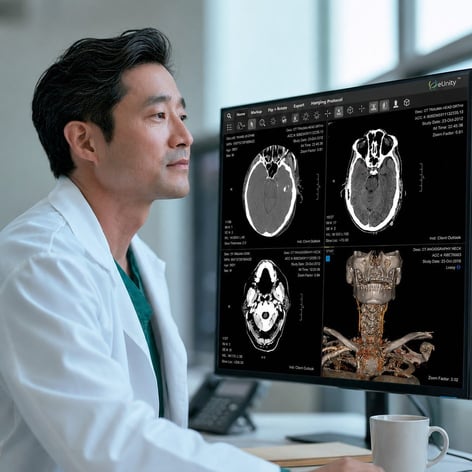
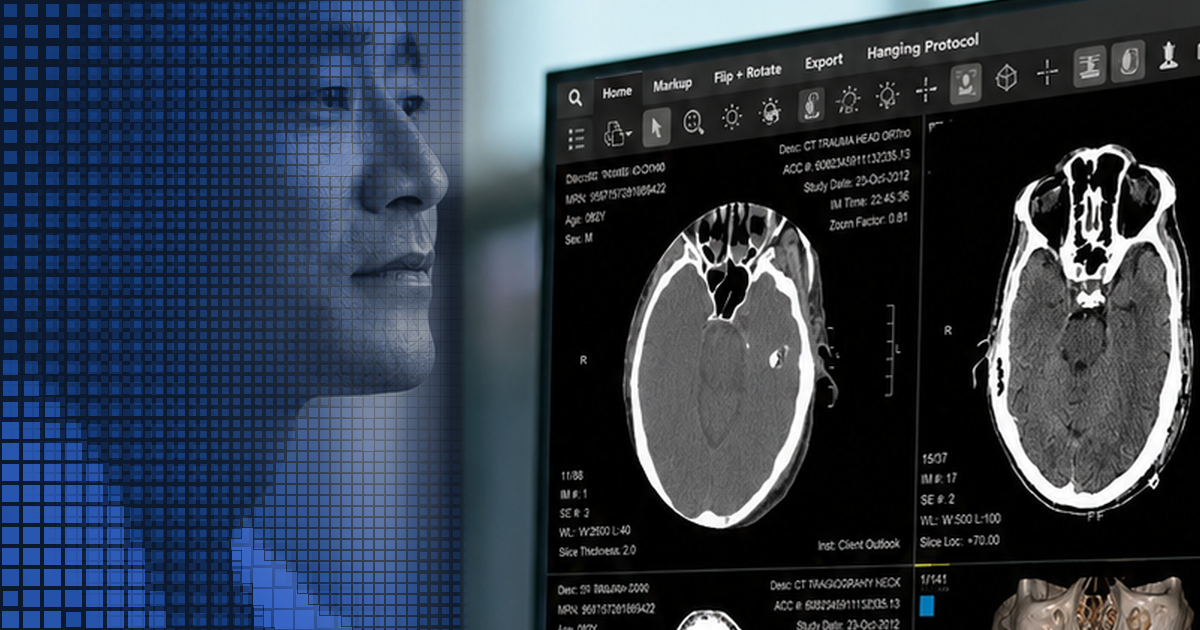
eUnity runs in the browser with nothing installed on the endpoint, supporting reading from home, on the road, or across facilities. No image data or patient information is stored on the device, and communication is encrypted.
Cloud-Direct Performance
When EIP is tightly integrated with eUnity, Object Store and Intelligent query response modes let the viewer reach studies in AWS S3 object storage directly, with optional caching — rather than staging every study through a local cache before the reader sees it.
Vendor-Independent by Design
Standards-native throughout — DICOM, HL7, WADO-RS, QIDO-RS, MWL — with no proprietary internal storage format and migration tooling included. Change a viewer, an archive tier, or a cloud without changing everything else.
Deliver Value for your Patients
The Data Layer — EIP & VNA
- Zero-footprint diagnostic-quality clinical viewer
- Utilized by referring physicians, clinicians and general users
- Integrates data from any source
- Completes EMR with a full imaging history
- Toolset to support clinical subspecialities
The Worklist — Orchestration
- Zero-footprint diagnostic viewer
- Advanced reading features and toolsets
- Utilized by providers for diagnostic interpretation
- Supports teleradiology and telehealth services
- Inherent clinical workflow to support diagnostic confidence
- Full mammography reading
The Viewer — eUnity
- Consolidates viewing solutions
- Connects siloed data repositories
- Improves clinician satisfaction and efficiency
- Provides a vendor-independent viewing platform
- Displays patient’s complete imaging history
- Supports diagnostic confidence
- Robust interoperability to EMRs and external systems
The Mach7 Family Behind Every Remote Read
Enterprise Imaging Platform & VNA
The open imaging data layer — archive, workflow engine, universal worklist, lifecycle management, and migration tooling in one vendor-neutral foundation, deployable on-premises, in the cloud, or hybrid.
eUnity Enterprise Viewer
Mach7’s zero-footprint viewer for reading across sites and specialties, with advanced visualization and support for external AI-enabled integrations.
Customer Success Stories
“I have been a remote radiologist for over eight years, and have worked on many different teleradiology mammography reading platforms. eUnity is far superior in every way. Mach7 has really nailed it! I was impressed with the functionality, and study download speeds were instantaneous.”
Gale Sisney, MD, FACR - Fellowship Trained Breast Imager, DocPanel
*Mammography is subject to additional US regulatory controls. eUnity is not intended for diagnostic interpretation of mammography or digital breast tomosynthesis on mobile devices; use a compliant diagnostic workstation.
+50%
Total mammography coverage
50%
Fewer resources needed per read
Frequently Asked Questions
-
Do we have to replace our PACS to read remotely?
No. Mach7 is deconstructed by design: the archive, the workflow engine, the worklist, and the viewer are separable. Many teleradiology deployments start by adding routing and a zero-footprint viewer over the systems already in place, then consolidate the archive later if it makes sense.
Because the data layer is standards-native, adding Mach7 does not commit you to replacing anything else.
-
How do radiologists get priors when they read off-site?
Prefetch rules in the Workflow Engine retrieve comparison studies ahead of the read, and query spanning surfaces exams held in external or distributed archives on demand.
C-FIND prefetch actions can count priors by unique accession number, so studies that share an accession are treated as one prior and the intended number of distinct comparisons is retrieved.
-
What does a remote radiologist need installed?
Nothing. eUnity is zero-footprint and runs in a modern web browser, so a reader can work from a home office, a laptop, or another facility without a provisioned workstation. No image data or patient information is stored on the device, and communication is encrypted.
Diagnostic display monitors must still meet applicable regulatory approvals and quality control requirements for their use and maintenance. For the current supported browser, operating system, and mobile matrix, contact your Mach7 representative.
-
Can we run this in the cloud?
Yes. Mach7 EIP deploys on-premises, in the cloud, or hybrid, with cloud archiving and lifecycle policies that tier long-term data while keeping active imaging close to the reader.
Where EIP is tightly integrated with eUnity, the viewer can also read studies directly from AWS S3 object storage rather than staging them through a local cache first. For supported cloud services and infrastructure prerequisites, contact your Mach7 representative.
-
Can we support multiple sites or client organizations?
Yes. Routing rules can pass through the source calling AE title so outbound transfers carry the original sender, and spanned DICOM Modality Worklist queries can forward it too — which keeps studies attributable to the right site or client across a distributed reading arrangement.
Granular role-based permissions and SAML single sign-on govern who sees what.
Flexible Remote Reading, One Unified Archive
See how Mach7 supports distributed radiology teams.
Request a DemoeUnity is a diagnostic viewer intended to display medical images and associated clinical reports to aid in diagnosis by trained healthcare professionals. Professional and prescription use only. In the United States only, eUnity supports digital pathology whole-slide imaging (WSI) for reference and referral use and is not intended for primary diagnosis. Mammography and digital breast tomosynthesis are not intended for diagnostic interpretation on mobile devices. Mach7 Enterprise Imaging Platform is intended for archiving, communicating, and viewing medical imaging data. Its built-in viewer is non-diagnostic and is used for reconciliation and quality control; diagnostic viewing is provided by eUnity, a separate product in the Mach7 family. Product availability, regulatory status, intended use, and feature availability may vary by country, region, and care setting.