

Sensitive Images Need Tighter Control

Trauma, wound care, images of minors, forensic and high-profile cases sit in the same imaging record as everything else — and reaching them should not be as easy.

Not Every Image Should Be Equally Visible

Smart devices now capture clinical photography well outside traditional DICOM equipment, and a HIMSS-SIIM white paper set out what that means for the management, control and privacy of the images being taken. The documentation is better; the governance has not kept up. A provider’s ability to keep firm control over who reaches certain images has become a requirement, not a refinement.

Icon

IMAGES FROM OUTSIDE THE DICOM WORLD?

Phones and consumer cameras capture clinical photographs that never pass through a modality, and they land wherever the application that took them decides.

Icon-1

SCATTERED ACROSS DEPARTMENTS?

Wound care, dermatology and forensic photography often sit in departmental systems outside the imaging record, where enterprise access rules do not reach them.

Icon-2

ONE ARCHIVE, ONE LEVEL OF ACCESS?

When every study is equally reachable, a trauma series is as easy to open as a routine chest X-ray — and nobody set out to design it that way.

One Imaging Record, Governed Access

The Missing Piece in Your Imaging Strategy

Excepteur sint occaecat cupidatat non proident, sunt in culpa qui officia deserunt mollit anim id est laborum.

Lorem ipsum dolor sit amet, consectetur adipiscing elit, sed do eiusmod tempor incididunt ut labore et dolore magna aliqua. Ut enim ad minim veniam, quis nostrud exercitation ullamco laboris nisi ut aliquip ex ea commodo consequat.

Duis aute irure dolor in reprehenderit in voluptate velit esse cillum dolore eu fugiat nulla pariatur. Excepteur sint occaecat cupidatat non proident, sunt in culpa qui officia deserunt mollit anim id est laborum.

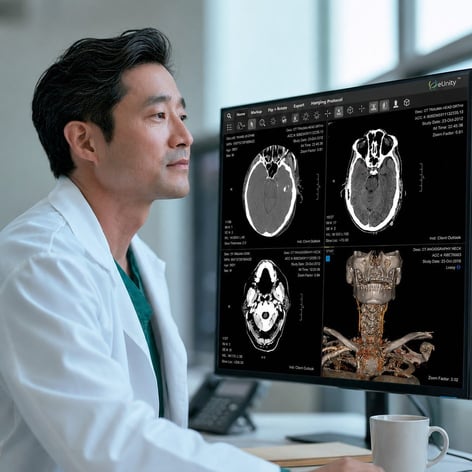
eUnity diagnostic viewer, dual-monitor reading workstation.

How Mach7 Handles Sensitive Imaging

Vector (6)

Granular Role-Based Permissions

Access is governed by granular role-based permissions, so a user reaches what their role allows across the imaging record rather than whatever a departmental system happens to expose.

Multi-Specialty Reading

Single Sign-On

SAML single sign-on means imaging access follows the identity provider you already run. Roles change and accounts close in one place, and imaging follows.

AI Integration

Nothing Left on the Endpoint

eUnity stores no image data or patient information on the device, and communication is encrypted — so a sensitive study is not left behind on a laptop, tablet or shared workstation after the browser closes.

Advanced Visualization Tools

DICOM and Non-DICOM Together

Wound photographs, video, PDFs and scanned forms are archived alongside radiology in one vendor-neutral archive, in native format or DICOM-wrapped, with no proprietary conversion.

Cross-Enterprise Workflow

A Single Index of Record

One index across departments means a sensitive image is findable, and therefore governable, in one place instead of on a departmental drive nobody is auditing.

Mobile & Remote Reading

Standards-Native and Portable

Standards-native storage with no proprietary internal format, so the archive holding your most sensitive images stays portable and provably yours.

Deliver Value for your Patients

Archive — Enterprise Imaging Platform & VNA

Sensitive studies and the photographs that go with them land in the same vendor-neutral archive as the rest of your imaging, with a single index of record across DICOM and non-DICOM objects. Nothing has to be parked in a departmental system to be kept.
  • Zero-footprint diagnostic-quality clinical viewer
  • Utilized by referring physicians, clinicians and general users
  • Integrates data from any source
  • Completes EMR with a full imaging history
  • Toolset to support clinical subspecialities
Radiologist at an enterprise reading-room workstation.

The Products Behind It

Enterprise Imaging Platform & VNA

The open imaging data layer: archive, workflow engine, worklist, lifecycle management and migration tooling in one platform, holding DICOM and non-DICOM objects under a single index of record.

eUnity Enterprise Viewer

Mach7’s zero-footprint viewer, reading across specialties from a single patient imaging history, with no image data stored on the endpoint device.

Frequently Asked Questions

Questions About Access or Privacy Controls?

Talk to our team about how sensitive imaging is protected.

Connect with us

The Mach7 Enterprise Imaging Platform’s built-in viewer is intended for clinical and quality-control review — reconciliation, merging, splitting, presentation states, and measurements — and is not intended for diagnostic interpretation. Diagnostic viewing is provided by eUnity, a separate product in the Mach7 family. Mammography and digital breast tomosynthesis are not intended for diagnostic interpretation on mobile devices.