


Where do your POCUS images actually live? A practical guide to keeping point-of-care ultrasound findable, retained, and accessible in your enterprise imaging archive and viewer.
9 page PDF 7 checklist items 6 governance essentials 10 minute read
The framework
- 01 The one-page POCUS governance checklist Free to read below
- 02 Who owns what: an honest map Free to read below
- 03 Why POCUS is a data problem, not just a device decision In the download
- 04 What a phantom scan actually costs In the download
- 05 What good governance looks like In the download
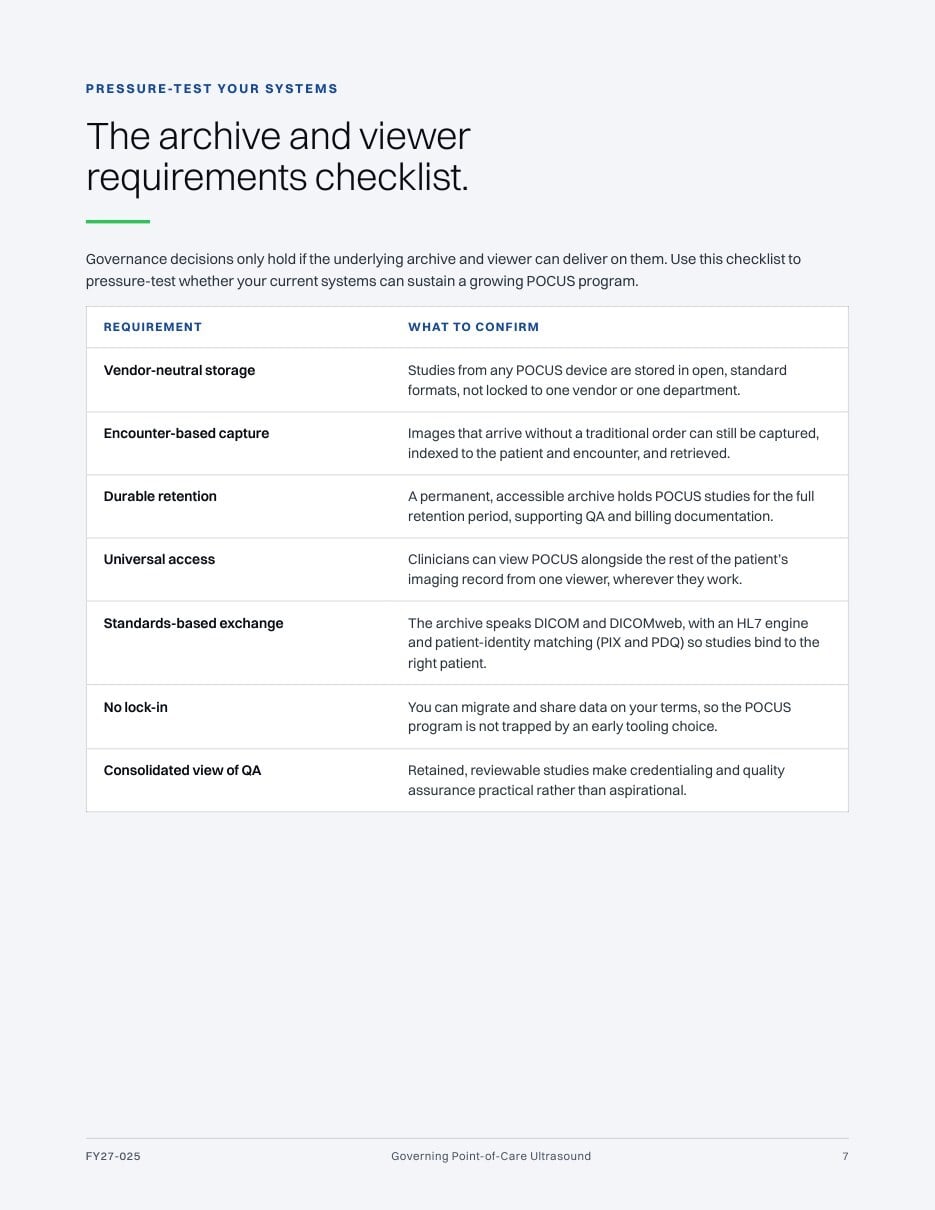
- 06 The archive and viewer requirements checklist In the download
- Where Mach7 fits, and getting started In the download
Start here: the one-page POCUS governance checklist
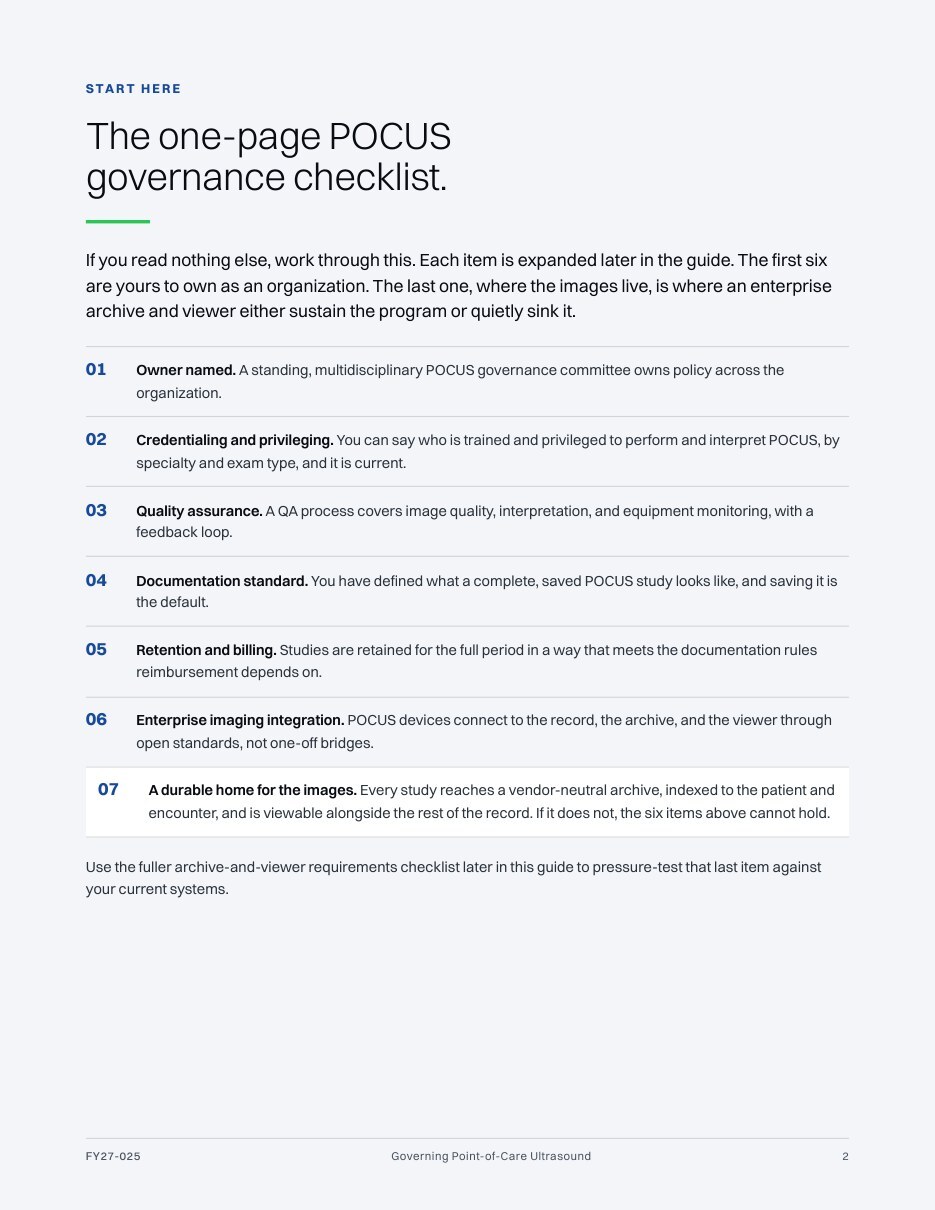
If you read nothing else, work through this. Each item is expanded later in the guide. The first six are yours to own as an organization. The last one, where the images live, is where an enterprise archive and viewer either sustain the program or quietly sink it.
- Owner named. A standing, multidisciplinary POCUS governance committee owns policy across the organization.
- Credentialing and privileging. You can say who is trained and privileged to perform and interpret POCUS, by specialty and exam type, and it is current.
- Quality assurance. A QA process covers image quality, interpretation, and equipment monitoring, with a feedback loop.
- Documentation standard. You have defined what a complete, saved POCUS study looks like, and saving it is the default.
- Retention and billing. Studies are retained for the full period in a way that meets the documentation rules reimbursement depends on.
- Enterprise imaging integration. POCUS devices connect to the record, the archive, and the viewer through open standards, not one-off bridges.
- A durable home for the images. Every study reaches a vendor-neutral archive, indexed to the patient and encounter, and is viewable alongside the rest of the record. If it does not, the six items above cannot hold.
Use the fuller archive-and-viewer requirements checklist later in this guide to pressure-test that last item against your current systems.
Who owns what: an honest map
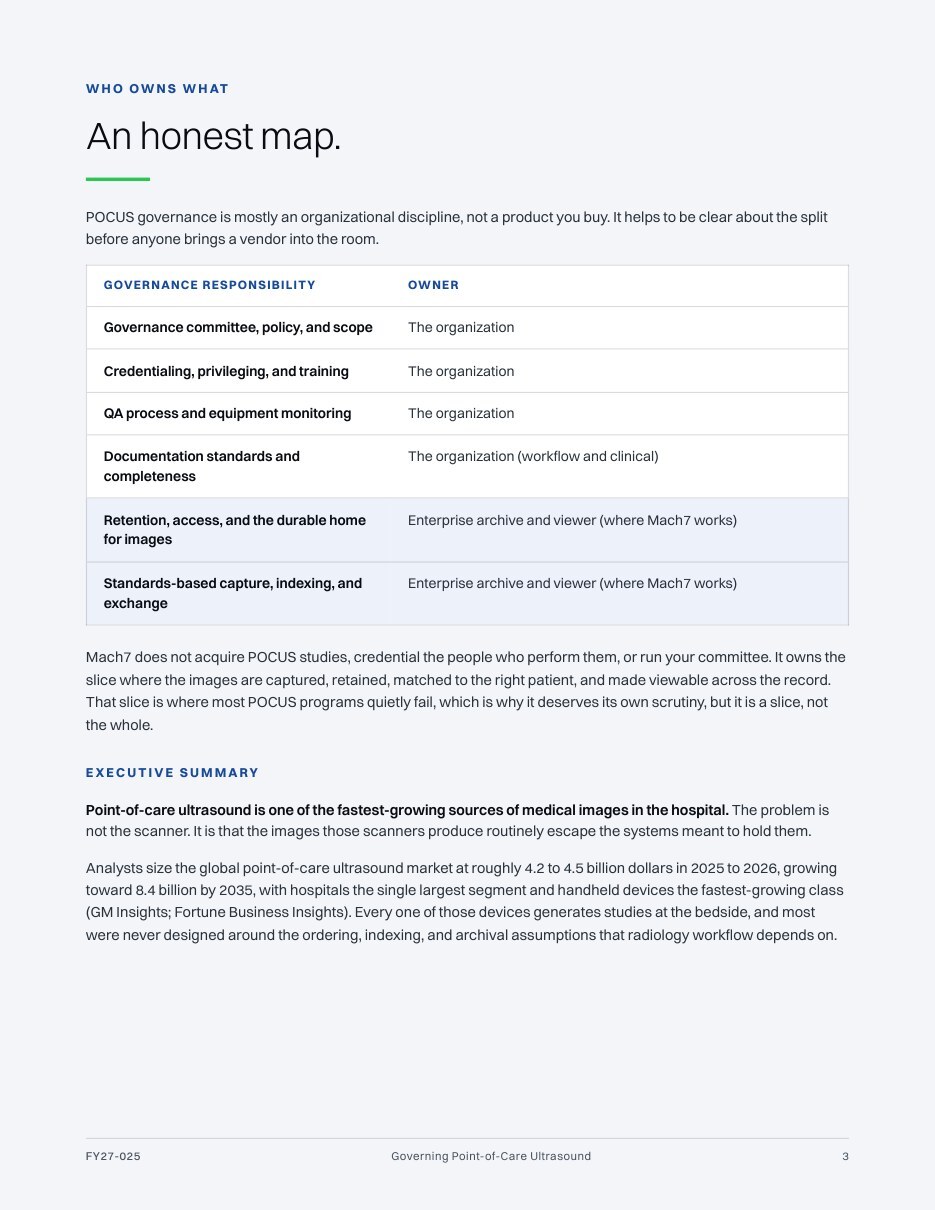
POCUS governance is mostly an organizational discipline, not a product you buy. It helps to be clear about the split before anyone brings a vendor into the room.
Mach7 does not acquire POCUS studies, credential the people who perform them, or run your committee. It owns the slice where the images are captured, retained, matched to the right patient, and made viewable across the record. That slice is where most POCUS programs quietly fail, which is why it deserves its own scrutiny, but it is a slice, not the whole.
In the United States, eUnity is an FDA-cleared Class II medical device (510(k) K172490) that enables healthcare professionals to view, manipulate, and analyze medical images to aid in diagnosis. Professional and prescription use only. This guide addresses image management, retention, access, and governance, not the clinical interpretation of POCUS studies.
Regional availability and content notice. eUnity is a medical device for professional and prescription use by qualified healthcare professionals. Regulatory status, available modules and approved indications vary by market. For the approved indications in your market, contact your Mach7 representative or Mach7 Regulatory Affairs.
Look inside
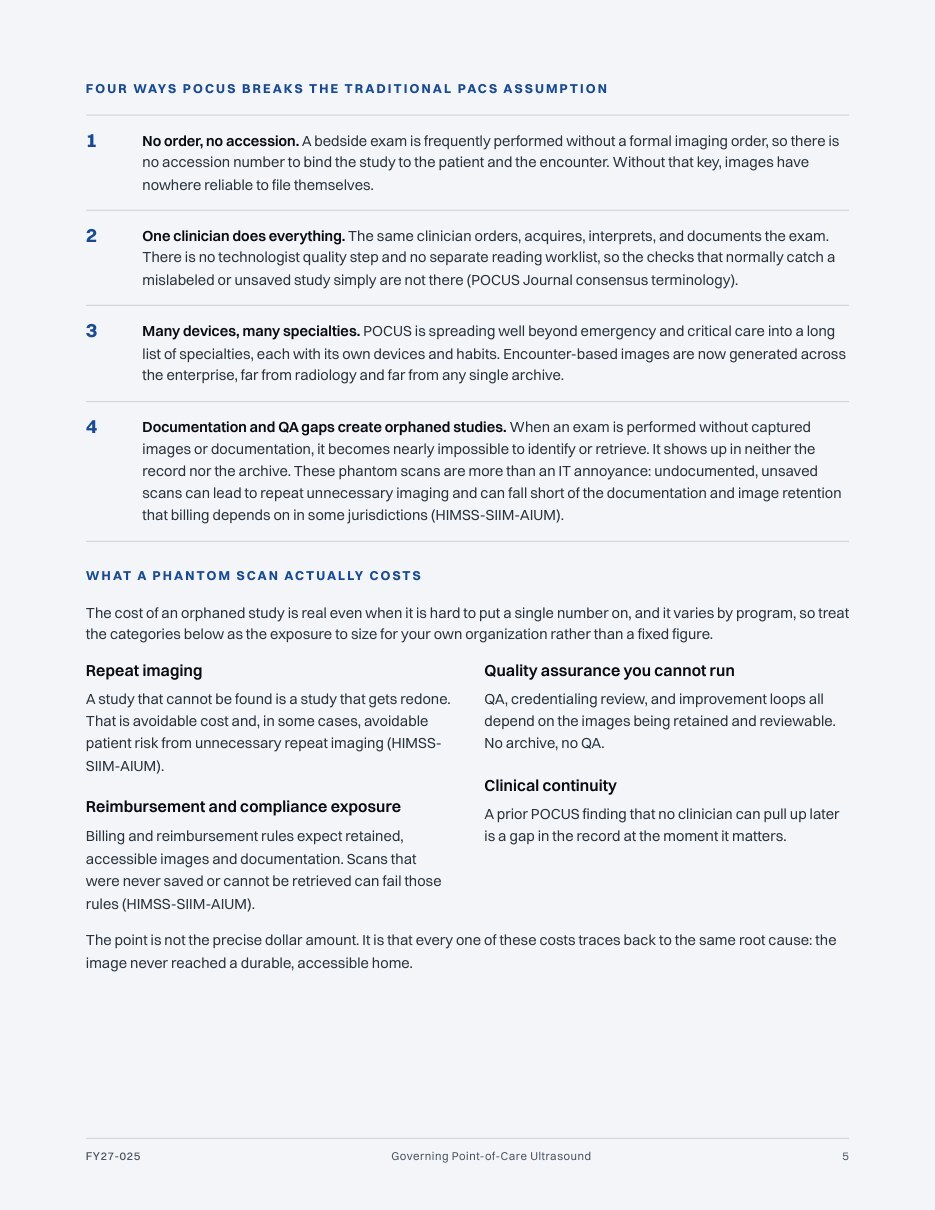
The point is not the precise dollar amount. It is that every one of these costs traces back to the same root cause: the image never reached a durable, accessible home.