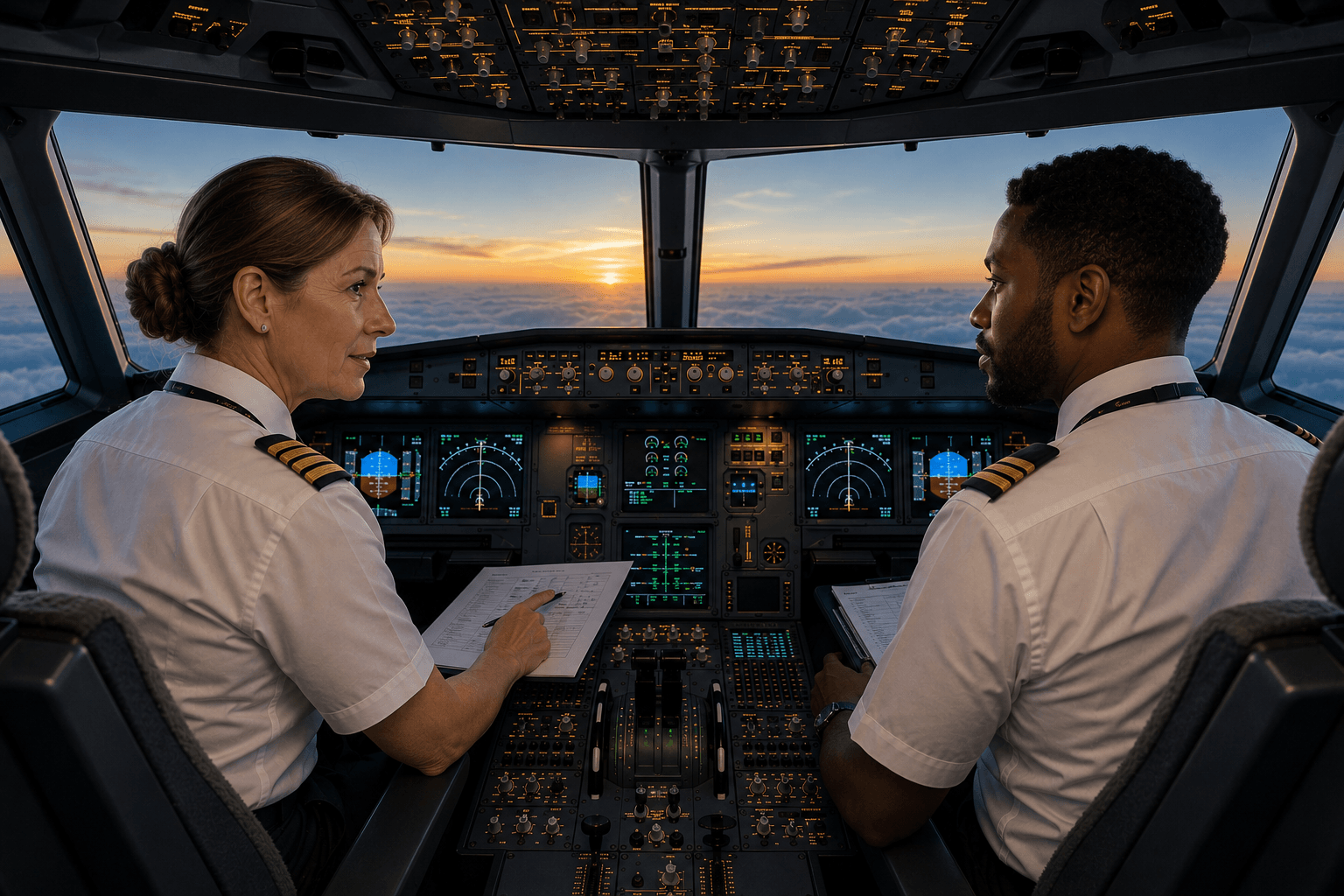
The automation in a modern cockpit is extraordinary, but it isn’t what gets you home.
Every major technology arrives with a wave of anxiety, and AI is no exception. It can draft, summarize, analyze, and research faster than any person, and it is already reshaping how work gets done across healthcare. The real question for leaders is not whether to use it but knowing where it belongs and where it does not.
At Mach7, we have made a clear choice. We use AI wherever it makes our people faster and better at their jobs, and we keep people in the seats where outcomes are decided. We call this the flight crew model.
“Our customers trust us with their imaging operations, not just their software. That trust is built by people who know your environment, not by a portal. We use AI to make our crews faster and better, never to put distance between us and the customer.” Teri Thomas, CEO, Mach7 Technologies
Autopilot doesn’t fly the plane
Modern aircraft rely on remarkable automation. Autopilot handles most of the cruise, and the software takes care of the routine, so the crew can focus on what matters. Even so, no one boards a plane without a crew. The automation makes the crew more effective, not unnecessary.
The same is true for AI in enterprise imaging. The technology is the autopilot. The flight crew is the group of people who know your environment, see the turbulence coming, and stay calm when something goes wrong at 2 a.m. during a go-live.
So when you work with Mach7, you get more than a portal and a ticket queue. You get a designated team that knows your environment, owns your outcomes, and treats your migration, uptime, and roadmap as its own responsibility:
- Wingmate. Your day-to-day coordinator, who keeps tasks, schedules, and communication moving between your clinical teams and ours.
- Airboss. Your project lead from kickoff through go-live, responsible for scope, timeline, and budget, and for confirming you are ready at every stage.
- Code Pilot. The hands-on technical implementer behind your configuration, upgrades, and go-live support.
- Tech Viper. Your technical expert in areas such as database administration and imaging workflow, available for both urgent issues and long-term optimization.
- Flight Controller. The orchestrator who keeps your crew aligned, runs technical reviews, connects the roadmap to your adoption, and serves as your first point of escalation.
- Crew Catalyst. Works behind the scenes to make every crew sharper. If the Airboss keeps the plane in the air, the Crew Catalyst improves the cockpit so every flight goes more smoothly.
- ACE (Advocate for Customer Experience). Your co-pilot for the long term, who owns the relationship across your clinical, operational, and executive teams and makes sure you keep getting value well after go-live.
Where AI reaches its limits
The research backs this up. The World Economic Forum’s Future of Jobs Report 2025 found that 39% of workers’ core skills are expected to change by 2030, and that the skills rising fastest in importance are human ones such as analytical thinking, resilience, flexibility, and leadership. Leadership and social influence alone rose 22 percentage points from the prior edition, the largest single shift in the data.
A related analysis, summarized by Prialto in 7 Human Skills AI Can’t Replace, goes further. When researchers used a leading AI model to evaluate more than 2,800 specific skills for how easily a machine could replace a human, none scored “very high” for substitution, and skills such as empathy, active listening, and sensory judgment showed no substitution potential at all.
AI is excellent at finding patterns across large volumes of information, but it cannot read a room, weigh competing priorities under pressure, or take ownership of a high-stakes decision when the data is incomplete. Those are the capabilities that decide whether an imaging project succeeds, and they sit with people.
Where the crew earns its keep
Enterprise imaging is a long project with real stakes: patient data, clinical operations, regulatory obligations, and infrastructure you will depend on for years. A human crew makes the difference in the moments that matter most.
During complex migrations. Moving imaging data is rarely clean. It involves judgment calls about non-conformant data, sequencing, and risk that a script cannot make on its own. A crew that has done it before anticipates the problems and works around them.
When something breaks under pressure. A chatbot can route a ticket, but it cannot tell that a customer’s polite email is signaling a serious concern, or decide what to escalate and when. Catching a problem before it becomes a crisis takes a person.
When conditions change. A new regulatory requirement or a shift in your strategy calls for someone who can reinterpret the situation in real time, not a model working from last year’s assumptions.
In the relationships that build over time. Much of the work that protects a partnership is invisible: the check-in before a problem surfaces, the accountability when something goes wrong, the track record built over years. A model cannot build history with your team, but a crew that has worked alongside you can.
Better together
We are not skeptical of AI. We use it wherever it makes our people more effective, so our teams can spend their time on judgment, relationships, and the difficult conversations that move accounts forward. AI handles much of the process, while people own the judgment, the accountability, and the relationship.
The organizations that build a lasting advantage are not the ones rushing to remove people from the process. They are the ones using AI to make their best people more effective while keeping humans in the seats where trust and judgment decide the result. That is the flight crew model: strong technology flown by people who show up and stay accountable. The autopilot is impressive, but you still want a crew you trust in the cockpit.
Curious what a Mach7 flight crew looks like for your organization? Let’s talk.